
Existing PDFs become digital cases.With status changes, ownership and queries.
- Online application
- Workflow
- API
- MCP
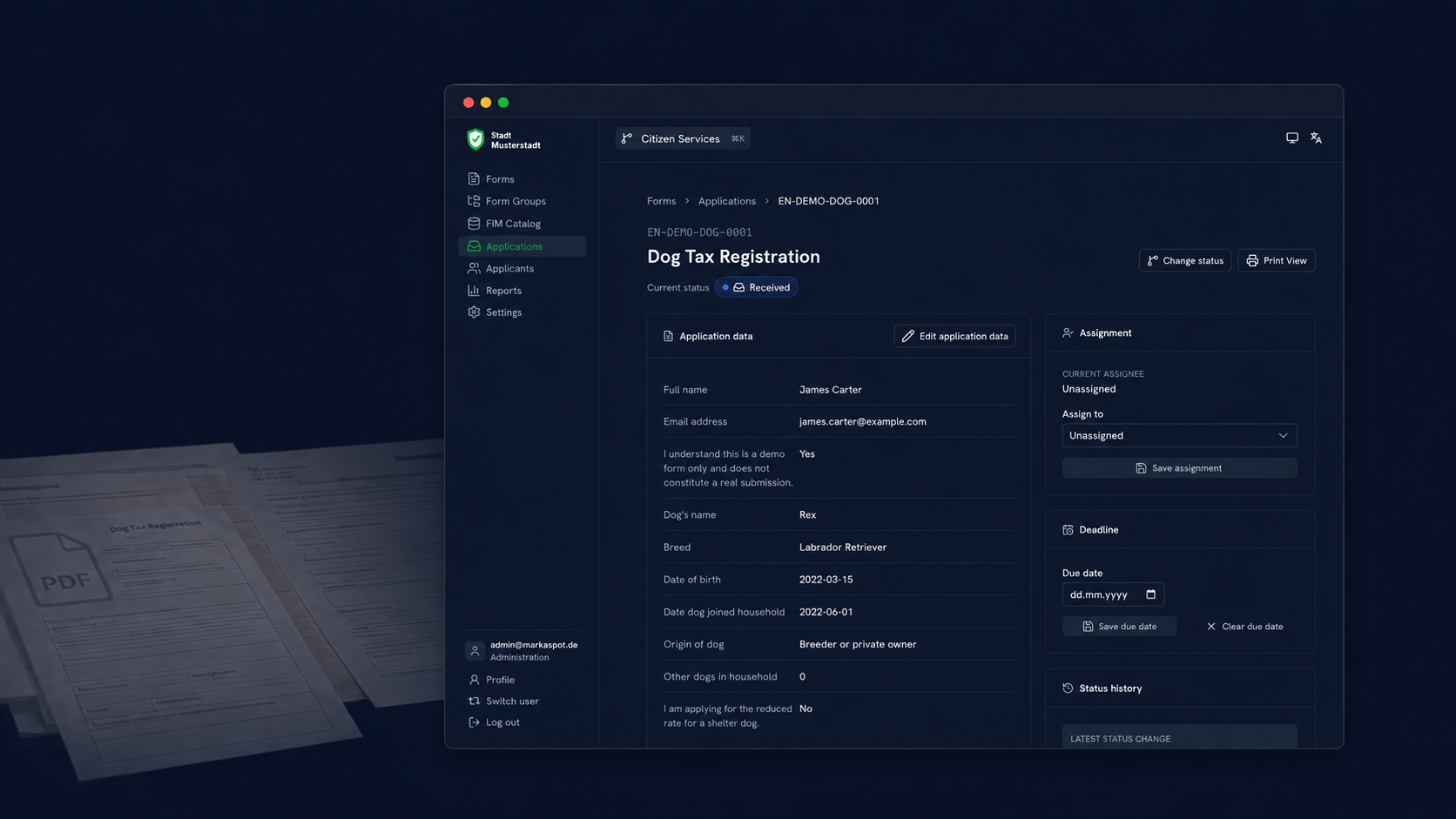
That was a PDF. Now it is a case.
Three steps from template to usable process.
Upload PDF, Word or scan. beantragt.ai creates a structured draft.
What do you want to achieve with beantragt.ai?
Form servers do not solve every PDF problem.
Ready to connect when you need it.
A PDF becomes an approved online application.
- Department
Upload a template, detect the structure automatically.
PDF, Word or scan starts the draft. AI detects sections, fields and hints. The department immediately sees what the online form will look like.
- Department
Review fields, set ownership, approve.
Required fields, labels, validations and routing are adjusted in the editor. Corrections work in plain language, without form-server training.
- Department
Submissions arrive as cases.
Every submission has a reference number, status and ownership. The department stays in control instead of sorting PDF attachments.
Cases instead of inboxes.
- Case worker
Status, queries and ownership in one place.
Every application follows the right workflow. Queries, handovers and processing steps stay documented on the case.
- Case worker
Internal notes stay internal.
Comments, queries and handovers are clearly separated from citizen communication. What is internal stays on the case.
- Case worker
PDF remains available, but it is not the process.
A filled PDF can be generated for print, filing or handover. The structured case stays the system of record.
- Case worker
Applicants with history.
Returning applicants and earlier cases are easier to find. Less searching, more context.
Submit digitally, receive confirmation, track status.
- Citizen
Submission with a reference number.
Submit online, upload attachments and receive confirmation. No printer, no paper detour.
- Citizen
Check status without an account.
Progress is available by link or one-time code. That reduces status calls to the department.
- Citizen
Upload evidence directly with the application.
Documents, plans and photos are attached during submission. No separate email attachment, no postal follow-up.
- Citizen
Multilingual without duplicate maintenance.
Forms can be provided in multiple languages without maintaining every variant separately.
Multilingual forms, here in English.
What makes beantragt.ai different.
AI assistants as a real intake channel
Through MCP, published forms are available as structured tools. AI assistants can capture requests, check required fields and hand submissions off as cases.
Structured standards and existing PDFs
Official form standards and existing templates can both be starting points. That reduces manual rebuild work and keeps subject-matter logic reviewable.
Plain-language corrections
Fields, labels and routing can be adjusted in the editor or by chat: "Postcode is required", "Remove section 3".
Protection for sensitive fields
Sensitive data is stored encrypted. GDPR Art. 9 fields are excluded from CRM, search and email.
Administrative structure built in
Directorates, departments and divisions can manage their own forms, responsibilities and permissions. Proven with 324 organisational units in one administration.
API-first, not an isolated form tool
Website, embed, specialist-system adapters, webhooks and MCP clients can use the same documented API contract. OpenAPI and example requests are included.
AI-assisted evidence and completeness checks
Uploaded attachments should be checked against an evidence schema: document type, completeness and plausibility. The result stays attached to the case. Human review remains decisive.
In preparation.
The AI assistant can accept applications, not just explain them.
- Finds the right form
- Captures details in dialogue
- Checks required fields before submission
- Hands the submission off as a case
Technically via API and MCP. No separate bot per form. The language model and operating model are configurable per tenant.
I want to register a change of use.
The change-of-use application is the right fit. I will guide you through the details.
Plot 412/3, changing from residential to commercial.
Noted. The application still needs the applicant name. What is the full name?
First name, last name
Required personal data belongs in protected fields, not in the language model.
Not passed as required field values
- First name and last name
- IBAN
- Date of birth
- Address
- Phone and email
In the model context
- Form structure without values
- Non-sensitive control data
- Free-text request
optional EU or sovereign backend
Free text can be processed by the model. Identifying information belongs in secured fields, not in the free-text request.
Trust and compliance
Positioning
Complements form servers instead of replacing them wholesale.
Existing portals, specialist systems and form servers stay where they are deeply integrated.
beantragt.ai closes the gap where forms remain stuck as PDFs, email workflows or small special cases, but still need to work across website, workflow, API and AI.
Background and trust signals
beantragt.ai is developed by Civic Patches. We build Mark-a-Spot, the open-source civic issue reporter for municipalities.
FAQ
Frequently asked questions
Start with the form that creates the most work today.
In the demo, we show how it becomes a digital application and a case your team can process. Then we discuss how beantragt.ai can be integrated into your organisation.
Request a demo